Death & Life
We are now at sermon number five in our series about The Story, which means it is probably a good moment to stop and do a little review and look ahead. I know it can start to feel like a lot to keep in your minds at times, when we are going through a long story like this. Imagine how hard it would be to explain the entire Lord of the Rings series or Harry Potter to someone for the first time. That would take quite a bit of explaining!
To help (I hope), I worked on a graphic to represent what we have taught and where we are still going:
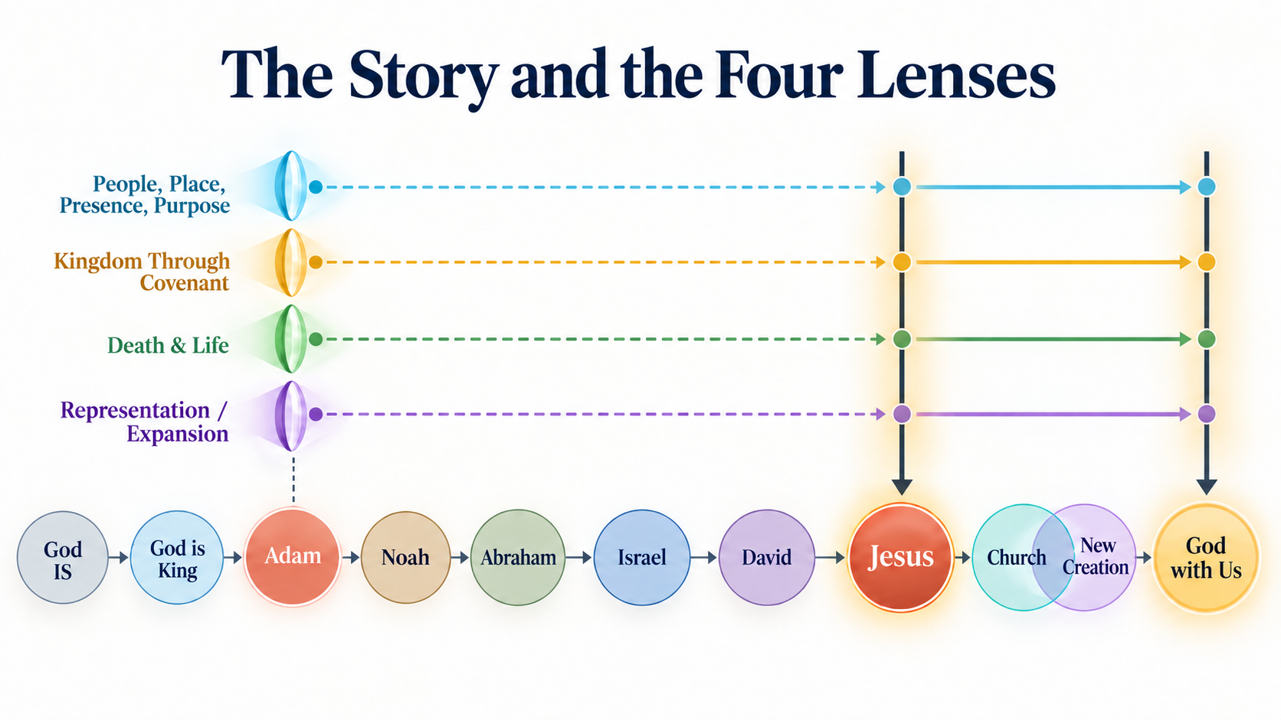
One of our organizing thoughts throughout the Story is that there are major moments in God’s interaction with us—usually around covenants—that teach us a lot about God and his love for us. And at each of these moments we see similar ideas repeated. Think of them as lenses—glasses we put on at each of these major stories, and even the smaller stories in between, to see the Story more clearly. There are many other lenses we could discuss, but these four are several of the major ideas.
We started this whole series where the Bible starts and where we must start—with God. God IS.
In the beginning, God…
(Gen 1:1)
He is The Story. We started with Romans 11:36 and talked about how all things are from him, through him, and to him. Everything that is created is here to bring God glory.
And God is King, which means all creation is his Kingdom. Astonishingly, he made humanity in his image—male and female—as image-bearers and he invites us to rule and reign UNDER his rule and reign. But we need to remember that we were created to rule, but never to be King.
It is there, in the Garden of Eden as we look at Adam and Eve, that we begin to see the four lenses we will come back to again and again at each step of the story.
The first lens, or repeating idea we see start in the garden, is WHAT God’s Kingship and Kingdom look like. If God is King and he has a Kingdom, that means he has a People, Place, Presence, and Purpose. A People—made in his image. A Place—where they live out their life with God. His Presence—God himself with them. And a Purpose—to reign and rule, protect and keep, to have dominion across this earth and spread God’s glory everywhere.
This is:
God’s PEOPLE, In God’s PLACE, enjoying God’s PRESENCE, fulfilling God’s PURPOSE.
Eden was the first expression of this idea, our first glimpse of that lens, and then that image continues on throughout the story. God will have his people, his place, with his presence, fulfilling his purposes.
The second lens, or repeating idea, is HOW God establishes his kingdom and how he relates as King to his people. And as Jack talked about last week, God establishes his Kingdom through covenants with people. Covenants order God’s relationship with his people. A covenant includes promises, commitments, commands, obligations, blessings, and judgements. But covenant is more than just rule-keeping or promise-keeping! Covenant describes our entire way of life with God, and God advances his kingdom purposes through covenant. Jack helped us define covenant last week when he said, “A covenant is a binding relationship established by solemn promises and commitments.”
Peter Gentry and Stephen Wellum wrote one of the great books about this idea of God’s Kingdom being built through his covenant, appropriately titled, “Kingdom Through Covenant.” They have done a lot of studying to help demonstrate that covenant is much more than just a contract or an agreement. Rather, as Gentry and Wellum say,
“At the heart of covenant, then, is a relationship between parties characterized by faithfulness and loyalty in love.” - Peter J. Gentry and Stephen J. Wellum, Kingdom through Covenant: A Biblical-Theological Understanding of the Covenants (Wheaton, IL: Crossway, 2012), 141.
Covenant is about our relationship with God. It is about faithfulness, loyalty, and love—and not our faithfulness, loyalty, and love, but God’s! And it is through his covenants that God is doing the work he always set out to do. As the pastor/scholar Doug Moo says,
“[Through] his covenants, God works to establish his kingdom.” - Douglas J. Moo, “Kingdom through Covenant: A Review,” The Gospel Coalition, September 12, 2012.
That last part is important. It is through the covenants that God establishes his kingdom. That means two things: God builds his Kingdom by means of his covenants, and he also reveals and advances that Kingdom through the succession of his covenants, with increasing clarity as the Story moves forward. That is what we are going to see as we move forward from Adam and Eve to Noah, Abraham, Israel, David and Jesus.
We are going to talk about the third lens today, but you’ll also notice there is a fourth lens on the graphic—Representation and Expansion. We can see hints of that idea in Adam and Noah, but it becomes much clearer when we reach Abraham, so we’ll introduce that one more fully in two weeks.
As we come to this third lens this morning, our next step in this Story, we need to consider the theme of Death & Life. As Genesis chapter two turns to chapter three, we are confronted with a new question: What happens when God’s covenant people rebel? And what we see here becomes another repeating theme throughout Scripture: Why does rebellion bring death? And how can a righteous God keep giving life to guilty people who deserve death?
Life and Death
Creation Covenant and Rebellion
Here we are, reading through the beginning of Genesis 1 and 2, and we see humanity’s life with God. There Adam and Eve are, in the Garden. God’s people, living in God’s place he created for them, walking in God’s presence, beginning to live out God’s purposes for them. As Jack noted, there is the tree they were forbidden to eat from—the Tree of the Knowledge of Good and Evil—set within an overwhelmingly generous creation God had given them.
Life wasn’t mostly about restricting Adam and Eve, but they did need to obey God. There was a test of whether humanity would trust the good King and remain within the covenant life he had given them.
And Adam and Eve rebel. They reject God’s word. They reject God’s rule. They are seeking self-rule—they want to decide for themselves what will be good and bring them life. In doing so, Adam and Eve are seeking God’s gifts without God. They are seeking life on human terms.
Here is the real tragedy of sin: Covenant rebellion is not merely breaking a rule or breaking a promise. Covenant rebellion is walking away from God’s intended way of life.
Adam and Eve are immediately driven from Eden. God himself drives them out of the garden in judgment, and he mercifully bars them from taking from the Tree of Life and living forever in their fallen condition. The People rebel. The Place is lost. The Presence is lost. The Purpose is abandoned. Cherubim guard the way back to the Tree of Life.
Humanity cannot simply return. Adam and Eve cannot walk back into the garden because they are now sinners. God’s holy presence is pictured as within the garden, while sinful humanity is now outside. The way back is blocked. They need a solution.
Even though Adam and Eve do not physically die that day, death has already entered the Story. But don’t miss the additional image of death that happens immediately—the image of exile.
Exile is death made visible.
Exile shows us what death is—separation from the source of life—long before Adam’s and Eve’s bodies finally die. A pattern has emerged because humanity has rebelled against God: Sin → Exile → Death
Death
That is why we start this morning with the idea of death. None of us likes to think about death very often. But I DO remember one moment when death became very visible in my family’s life—a moment that was both shocking and, strangely, funny. Death can be a sensitive subject, so I’ll spare you some of the details.
When our kids were young, we had a house with an acre of land and we raised chickens. BEFORE it was cool to post about it on Instagram. Before Instagram! And I had been telling our small group—our Gospel Community—how the phrase “like a chicken with its head cut off” came about because it really is a quirky aspect of what can happen when you choose to “harvest” a chicken. I don’t think most of our friends—none of whom had raised chickens—really believed me.
So, there we were, on our GC night. I invited anyone who wanted to see this phenomenon to come on outside with me—it was time to “harvest” one of the chickens. It was mostly the fathers, but one mom and several kids came out. Our kids were all younger: Hannah was about 6, Gabe 5, Abby 4, and Gideon was 2. They all came outside with me, including Katie and Hosea, who was just a baby. The rest of the group, who were not interested in this process, stayed inside the house.
So, we proceeded to do what you do in this moment to harvest chickens, and I let the chicken go. Sure enough, just like I told them, the chicken took off across the field, zigging and zagging, back and forth. And then, it headed straight back toward our group.
There was some scrambling and shrieks—from the kids, and maybe from a father or two. And there is little Gideon. My little mouth-breathing two-year-old, watching in amazement, and not moving an inch. And that was the moment the chicken tackled Gideon. Down he went, and the chicken stopped.
At this point, it looked like Gideon and the chicken had BOTH had an experience. Gideon was covered from head to toe in blood. And I got to have the joy of carrying him back in the house, all the while saying again and again to the people who did not want to be a part of this experience, “He’s fine. He’s okay. Don’t worry. None of it is his.”
This is one of our funnier family stories in hindsight, but it was visceral and shocking for the moms inside, whose first glimpse of our fun field time was me carrying Gideon through the door looking like a tragedy.
It was shocking because most of us rarely see death up close. Our modern culture often keeps death out of sight. It usually happens in hospitals or care settings—places that are sterile, clean, and professional. That is actually a good thing and often necessary and loving for families. But one unintended cultural effect is that suffering and dying can become removed from ordinary life. Death becomes unfamiliar. Death becomes easy to abstract.
Now, we all know what death is biologically. We know what it means for a flower, a bush, a chicken, or a relative to die. But Scripture forces us to understand death theologically.
Why Death? And Why So Much Death?
And we understand death by remembering that God is the source of life. Remember how Paul said it in Romans:
For from him and through him and to him are all things. To him be glory forever. Amen.
Romans 11:36 ESV
Everything is from God, through God, and to God. Creaturely life—the life of all things that God has created—is dependent life. Humans do not possess an autonomous life. We live from God, through God, and to God.
And what sin seeks is impossible independence. All of humanity, starting with Adam and Eve, wants:
God’s world without God’s rule.
God’s gifts without God’s presence.
Life without dependence upon God.
Sin is nothing less than rebellion against the source of life himself. Humanity sought independence from God. And Genesis chapter three shows what independence from God means: exile and death.
As I said already, exile is death made visible. As Adam and Eve lose the Garden, as they lose the presence of God, as the cherubim guard the way back and the Tree of Life becomes inaccessible, the spiritual reality of death becomes tangible for us.
And what we see through the imagery of exile is that death is both the consequence AND the judgment for sin. First, it is a consequence of our choices. To reject the God of life is to choose death. Separation from the source of life cannot produce life. That is why the independence we are all looking for is impossible. We cannot find life if we are seeking it apart from God.
Where might you be doing that today? Maybe it is in your career, maybe it is in your comfort, maybe even in good things like your family and even in ministry. We cannot find life apart from God, even in very good things. All things—including real life—are from him, through him, and with him. God is quite gracious to us in that he won’t let us find life anywhere but in him.
Second, we see in the imagery of exile that death is also a judgment. God pronounces the sentence on Adam and Eve. He sends them out, and he bars their return. Death is judicial, not merely natural.
And we are meant to hold both of those together in tension. Death corresponds to what humanity chooses in our sin, and death is God’s righteous punishment of sin. Death is what we choose, and death is what we deserve.
Paul interprets this idea of death and life that we see start in Genesis for the Romans in chapter five of his letter. Notice what he says there:
Therefore, just as sin came into the world through one man, and death through sin, and so death spread to all men because all sinned…For if, because of one man’s trespass, death reigned through that one man, much more will those who receive the abundance of grace and the free gift of righteousness reign in life through the one man Jesus Christ…so that, as sin reigned in death, grace also might reign through righteousness leading to eternal life through Jesus Christ our Lord.
Romans 5:12, 17, 21 ESV
Sin entered the world, and death came through sin. Adam’s sin brought condemnation and death to humanity, and every one of us then reenacts that same rebellion by choosing sin for ourselves. Death reigned.
That isn’t how it was meant to be! God is the King. We were meant to live and rule under his good rule and reign over our lives. Yet what fallen humanity now experiences is the reign of sin and death. And once death enters The Story, death is everywhere. That shouldn’t surprise us—God said rebellion would bring death.
In Eden, death is threatened, humanity rebels, and death enters the Story immediately. Adam and Eve are exiled, and God himself provides garments of skin to cover them—very likely involving the first animal death we see in Scripture. They are now living outside the Garden in a world marked by death, and their exile makes that spiritual reality visible.
Cain murders Abel. Lamech boasts about his killing as violence escalates. In Noah’s generation we see corruption, violence, judgment, and widespread death. With Abraham, even the promised son comes under the threat of death: Isaac carries the wood up the hill on his back, and Abraham is ready to sacrifice the very gift God gave him. Israel is brought out of Egypt through the judgment and death of Passover.
And what we begin to see in Scripture tied to sin and death is a pattern of sacrifice. More death. A temporary provision for atonement. A life given in the place of another. Death so that another might live. Perhaps this pattern begins already in the Garden, with God providing animal skins to cover Adam and Eve. But we see that by Genesis 4, Cain and Abel already know to bring sacrifices and offerings to God.
So we see sacrifices enter the story. And it doesn’t stop.
Another sacrifice.
Another death.
Another sacrifice.
Another death.
In each sacrifice we see a temporary and anticipatory image—something real God provides for that moment, but also something that points beyond itself to what is still to come.
The sacrifices teach us the seriousness of sin, the costliness of access to God as sinners, and the growing need for substitution if guilty people are going to live before a holy God. Death becomes associated with dealing with sin. And the repetition itself begins to expose the sacrifices’ incompleteness. If another sacrifice is needed again and again and again, then these sacrifices are not finally removing the problem of sin.
We should grow tired of death. You should tire of it as you read through the Old Testament, and you should tire of it in your life. Maybe you have felt that when you read through your Bible. The repeating experience of death should not simply become information or another data point. Rather, it should produce longing.
The people experiencing the sacrifices are meant to ask, we are meant to ask: How will we ever stop this cycle of death to cover over sin?
We live far removed from a culture of sacrifices so we may initially think this doesn’t apply to us. But it does! And we know it. We may not sacrifice animals still, but we do similar things today. We may not be killing a spotless lamb, but we quite often try to cover up our sin through self-imposed guilt, by just trying a little harder, or maybe even making sure we perform and do the right thing so we can feel better.
It may be less bloody, but we are often trying to perform our own version of sacrifices, because we have the same question: how can we cover over sin and escape death? My guess is everyone in this room can relate to that idea.
Hebrews chapters nine and ten later interpret this pattern of sacrifices that we see for us. Repeated sacrifices cannot finally remove sin. Their repetition reveals the incompleteness of the system, and Hebrews tells us what all that repetition was pointing toward: the need for a once-for-all sacrifice.
But Life Is Everywhere?!
Death is everywhere—in sacrifices and in the lives of people. But when we read Scripture, we see something else as well.
Life is everywhere too!
That raises the bigger theological question. Death is what we should expect in a world of sin. It is the consequence of our choice to sin, and it is also God’s judgment against sin. It exists throughout the sacrificial system, constantly pointing us forward to the need for a sacrifice that will finally suffice.
But why is there so much life? You may have never asked that question before as you have read Scripture, but life is everywhere in God’s story. God’s people keep receiving life from him. They receive preservation, promises, mercy, forgiveness, and life. Why? Why is that happening and, maybe more importantly, how is that happening? How can a righteous God keep giving life to guilty people who deserve death?
With Adam and Eve, death enters the Story, yet even in judgment God provides covering and preserves their lives. With Noah, the pattern grows clearer: sin brings judgment and death, yet God still gives grace and preserves life.
Therefore, we begin to see a different pattern emerge. With sin, we saw: Sin → Exile → Death
But now, in receiving life, we begin to see: Grace → Faith → Righteousness Received → Obedience → Life
God gives grace, we receive it by faith, righteousness is counted to us, obedience follows, and God gives life. And this is not a ladder by which people earn life. Unlike sin leading to exile which leads to death—something we choose in our sinning—this is not something we can make happen ourselves. Grace from God begins the whole movement, faith receives what God gives, righteousness is received from God rather than achieved, and obedience follows as the fruit of faith that started with God. Everything, from grace to life, is a gift initiated and sustained by God. And that is what we see even in the Old Testament.
Noah is not preserved because he earns his life. He is preserved because God gives grace, Noah receives God’s word by faith, that faith produces obedience, and God preserves him. With Abraham, we are told this even more explicitly. God graciously gives Abraham promises. Abraham believes God. His faith is counted to him as righteousness. That faith then produces obedience as Abraham continues to walk with God, and God brings life where there should be no life.
God gives grace, we receive it by faith, righteousness is counted to us, obedience follows, and God gives life.
Israel as a nation doesn’t show every step the way Noah and Abraham do—not every Israelite had saving faith—but Israel shows the basic order clearly. God chooses his people. God remembers his covenant. God redeems them. God brings them out of Egypt. Only THEN does he command their obedience.
God never says to us, “Be obedient and earn your redemption.” Perfect obedience is what righteousness requires, but as sinners, that is not something we can produce. That is true for us and it is true for Israel in the Old Testament. God’s commands come to a people he has already redeemed. And we are meant to see that if it were up to Israel—and if it were up to you and me—our obedience could NEVER earn our redemption.
No. God has a much better plan! God gives grace, we receive it by faith, righteousness is counted to us, obedience follows, and God gives life.
We see the same grace in David. David celebrates that he has been forgiven. He celebrates that his sin has been covered. He rejoices that his sin is no longer counted against him. And in Romans 4, Paul points directly to David as another example of righteousness received apart from works.
So here are more interesting questions: Why isn’t there more death? [and] Why is there life at all?
We see death but often don’t realize there is also so much life. Why is that? How can the life be there? There is a deeper question behind that observation: How can a righteous God keep giving life to guilty people who deserve death?
How? How can God preserve Noah? How can God justify Abraham? How can God redeem Israel? How can God forgive David? Why does God keep giving covenant promises despite repeated human failure?
How can God keep showing mercy, forgiving sin, and giving life without simply overlooking evil? How can he remain righteous while justifying the guilty?
But now the righteousness of God has been manifested apart from the law, although the Law and the Prophets bear witness to it— the righteousness of God through faith in Jesus Christ for all who believe. For there is no distinction: for all have sinned and fall short of the glory of God, and are justified by his grace as a gift, through the redemption that is in Christ Jesus, whom God put forward as a propitiation by his blood, to be received by faith. This was to show God’s righteousness, because in his divine forbearance he had passed over former sins. It was to show his righteousness at the present time, so that he might be just and the justifier of the one who has faith in Jesus.
Romans 3:21–26 ESV
In Romans 3 Paul gives us the answer. In earlier times God “passed over former sins.” This is what theologians call divine forbearance. God did not ignore sin. He did not lower his holiness. He did not pretend death was not deserved. God knew better than any of us what it would cost him to be able to give grace, faith, and ultimately life to his people. It would cost him his Son.
The cross demonstrates for us God’s ultimate righteousness. The sins God had previously passed over—in forbearance—were not forgotten. God’s righteous judgement against sin would be dealt with in Jesus Christ.
The cross explains for us how there can be life in The Story. Why it isn’t always immediate and constant death. It explains how God could righteously give life before the cross. Christ’s work was future in history, but it was always certain in God’s purpose. God could show mercy beforehand because Christ’s sacrifice was not just a possibility in God’s plan. It was certain. The cross was always where the Story was going.
God never had two ways of saving his people. Before Christ, God’s people received his promised grace by faith, while their salvation ultimately rested on Christ’s future work. After Christ, we receive that same grace by faith, but now our salvation rests on the work Christ has accomplished.
They trusted promised grace looking forward.
We trust accomplished grace looking back.
One saving plan.
One grace.
One Savior.
This was not a small problem, and God always knew the answer. In 1 Peter 1:10–12 we are told the prophets searched and inquired carefully into the salvation they were announcing, and even angels longed to look into these things. The Old Testament itself creates this growing anticipation: God is giving grace, forgiveness, and life—but the full answer to how and why he can do that it is still coming. And now we see that answer in Jesus Christ.
Kingdom Through Covenant to Life
As we have already said, God carries his Kingdom forward through covenants. And we are going to see that God’s covenant partners—humanity—repeatedly fail. The answer is not that we need a better human covenant performance. Rather, we need God to provide THE faithful covenant Son. When we get there, everything we have been tracing—People, Place, Presence, and Purpose, Kingdom, Covenant, and especially death and life, converges in Jesus.
Jesus is the faithful One towards whom the Story has been moving. He is the better Adam, the promised Son, the Passover Lamb, the true Israel, the greater David, the faithful covenant Son.
Think back again to Romans 5:
Through Adam: sin enters, condemnation comes, death reigns. Through Jesus: obedience is offered, grace abounds, righteousness is given, the guilty are justified—and life reigns! And Jesus isn’t merely a better example than Adam. Jesus is the better representative! Because that is what you and I need. We don’t just need someone to show us how to live rightly as God’s sons and daughters (though Jesus does do that). Rather, we need someone to stand in for us. The problem of death is overcome not by our covenant faithfulness, but by HIS covenant faithfulness.
And his covenant faithfulness continues to bring life. Because Christ has died and risen, God gives his people the Holy Spirit now. We are told that the Spirit is the first fruits of what is to come (Rom. 8:23), a guarantee or down payment of our inheritance (Eph. 1:13–14; 2 Cor. 5:5). That means, you and I are currently living in an already-not-yet moment.
Real life has begun. God’s presence is restored to you and me through his Spirit. Even though our bodies remain mortal, we still battle sin, and creation still groans. Even though we ourselves are said to be outwardly “wasting away” in 2 Corinthians 4:16, we are beginning to get tastes and glimpse of the new creation to come. The life of the age to come is already beginning to break into this dying age.
And this future is certain! It is secure because Jesus Christ is already risen. In Revelation, John says:
And between the throne and the four living creatures and among the elders I saw a Lamb standing, as though it had been slain…
Revelation 5:6 ESV
The Lamb was slain—that means the sacrifice was real. The Lamb was standing—that means the death did not win. The final defeat of death is not merely something we hope for. It has been secured by the death and resurrection of Jesus Christ!
The Lamb who was slain is standing!
Death doesn’t get the final word. That is why for many of us who feel deeply the grief of loss through death, we can be hopeful. Death has been conquered. The Lamb is standing and reigning.
Conclusion
And there we have Gideon again, covered in blood that was not his own. Visible evidence that another had died.
Blood may shock many of us because death is often unfamiliar and hidden. But after following the Story, we should no longer be surprised that blood appears throughout The Story. Death is everywhere, because sin is everywhere. Sacrifices exist to repeatedly point towards life through the death of another. Revelation 7:14 even pictures God’s people in robes washed in the blood of the Lamb. The question is: How can a righteous God keep giving life to guilty people who deserve death?
How? Well, Scripture repeatedly shows us that life comes through the death of another. And that substitute is ultimately the Son of God himself, who came to die for us. His blood was shed. He was the Lamb who was slain. But He Is STANDING! Death did not win. He lives. And because he lives, his people live. Life!
Summary
So, how would you summarize that? Imagine you have already shared with someone about God and his story, his kingship, and his kingdom; about Adam and Eve as his people, in his place, with his presence, living out his purpose; and about God’s gracious ways of relating with his people through covenant. How would you then pivot to this idea we see in the Garden of Eden and then again throughout the Story—the reality of life that is still present where only death should reign? Take a moment and try to write down some notes for yourself.
Again, not something you need to copy, but here is my quick summary:
Humanity’s rebellion brought death. But God began revealing a pattern: God provides the sacrifice; the substitute dies; God’s People live. The Story begins teaching us to wait for the provision God himself will give.