As many of you know, I have done several remodels during my lifetime. But one of my earliest memories is going with my dad to a little house he had bought in Nampa in the early 80’s that HE was remodeling to be a rental. He remodeled this over serval months, and he would often bring me with him—I guess to give my mom a break. He would give me a hammer and some boards, a paint brush, and then put me in a closet or up in the attic and let me think I was helping to fix-up something. Looking back, I wonder how helpful I really was!
I would like to think I have gained some skills since that time. But I still have moments where something doesn’t go right. I may start by thinking “maybe I can make it work,” but the project gets to the point where I can’t hide it anymore—what I was doing was just wrong! There have been times where entire walls have had to come back down because I wasn’t building it right. I’ve had entire sections of wiring I needed to rewire and there has been plumbing pipe cut out and reglued. There may-or-may not be evidence of these problems in my current house—I see them every day and it drives me crazy!
It’s hard to admit, but sometimes I build something wrong and I just have to start over. I need a fresh start. New studs, new wire, new sheetrock. There is just no hiding it and no good way to fix it. I need to redo it.
Corrupt World
This morning we come to the second covenant that we see in Scripture, the Noahic covenant. The second major moment we see the story move forward. This is the piece of Genesis we talked about most recently in our “In Between” series, and my job this morning is to help stitch it into the larger Story we are looking at in this series. And I don’t think it will feel like a repeat. In the context of the larger Story there are several things we didn’t talk about last time.
As we move out of Genesis 1–3 and the tragedy of the sin of Adam and Even in the garden, things don’t get any better in the Story. Things get bad very quickly. Cain kills Abel. Lamech kills a young man. In fact, when we get to Genesis 6 and the beginning of the Noah narrative, God says this:
The LORD saw that the wickedness of man was great in the earth, and that every intention of the thoughts of his heart was only evil continually. And the LORD regretted that he had made man on the earth, and it grieved him to his heart. So the LORD said, “I will blot out man whom I have created from the face of the land, man and animals and creeping things and birds of the heavens, for I am sorry that I have made them.”
Genesis 6:5–7 ESV
That is quite the statement! God says that every intention of mankind’s heart was only evil, continually. He says it even stronger in Genesis 6:
And God saw the earth, and behold, it was corrupt, for all flesh had corrupted their way on the earth.
Genesis 6:12 ESV
ALL flesh—all people—had corrupted their ways on the earth. God sees the corruption humanity has brought, grieves it, and declares judgment. This is the complete breakdown of the first lens we have been looking at in our story— the lens of God’s people, place, presence, and purpose.
God’s people have rebelled. They are no longer in his intended place. They no longer enjoy (or maybe even want?) his presence. They no longer even seem to desire to fulfill his purposes. And it extends even further. The King has built his kingdom, but his people have rebelled against his purposes. God sees their sin and now declares death.
Sometimes I think we might read a section like this in Scripture and think to ourselves “Well, yeah, it often looks like everything is just messed up and failing. That is what a sinful world looks like.” We assume this is just another news channel sensationalizing the issue to get our attention. But this is different. This is God’s assessment. This isn’t just HOW it looks—it really is that bad. Everyone has walked away from God.
And, at other times, I wonder if we also read this and think, “I agree. It is all awful! This world really is falling apart.” Perhaps that realization makes you angry, like the old person in their front yard shaking their fist at the young whippersnappers causing problems. Perhaps that makes you sad. You see sin all around you, you see your own sin, you feel the pain of lost place, presence, and purpose. I think we all do this at different points depending on how optimistic or pessimistic we might be feeling.
And then maybe, just maybe, we wonder:
God, do you see this?
The sin and suffering around us may make us wonder if God really is watching. You might wonder if God is just hanging out in heaven, enjoying himself while watching the angels play croquet on the front lawn like some aloof and unaware King. But that isn’t true. One of the things we are to be assured of from Genesis 6 is yes, God sees. He is intimately aware of problems. God does care.
God's Grace, Noah's Faith, and Life Through Judgment
But the problem isn’t God’s making. God created a good and perfect world. God created humanity made in his own image. So good that God declared it “very good,” in Genesis 1. This isn’t like me making my walls poorly and needing to start over. This is more like my dad putting me in the closet with some wood, nails, and a paint brush. I have no doubt that experiment did not go exactly like my dad wanted, and he likely had to fix some things along the way. That is what God is seeing. He created Adam and Eve, he sought Adam and Eve out in the garden BECAUSE he knew what they had done. God sees the mess humanity is making.
If you were God in this situation, what would you do? Humanity has thoroughly corrupted God’s world. God says ALL people are no longer pursuing his ways. And you may begin to have the same thought I have had during some of my construction failures. Let’s just start over. Get rid of these walls—get rid of these people. Start again with Adam and Eve 2.0…people who won’t take the fruit from the tree of the knowledge of good and evil.
At first, that is what it sounds like God may be doing in Gensis 6. God says he desires to wipe out all of humanity. But then we get to verse 8:
But Noah found favor in the eyes of the LORD.
Genesis 6:8 ESV
Most of us, when we read that, then continue straight ahead and go right into the next passage:
These are the generations of Noah. Noah was a righteous man, blameless in his generation. Noah walked with God.
Genesis 6:9 ESV
If we read it this way (which is normal), without pausing, we may think to ourselves—ahh, God found someone worthy! God looks around and, lo-and-behold, finds one guy who IS “righteous.” So, of course, God is going to do a redo, and he is going to use Noah because he will be better than Adam and Eve.
Sadly, if you know the story of Noah, you know that God won’t let us believe that he picked Noah because he was better than everyone else. We see very plainly that Noah sins, no less than we see that Adam and Eve sin. If we read this opening to this narrative as though Noah were picked for his outstanding righteousness, we are missing what God wants us to see, and putting a weight on Noah that he wasn’t asked to bear.
Genesis 6:8 concludes the section that begins with the generations of Adam in Genesis 5:
This is the book of the generations of Adam.
Genesis 5:1 ESV
Generations—toledot in Hebrew. This matters for how we read Noah. Genesis uses these statements to introduce new sections of the Story. Here, as we reach the end of the section beginning with Adam's generations in Genesis 5, everything is falling apart.
God's people are no longer in his place, enjoying his presence, or walking in his purposes. And just before we turn the page (as it were) to the account of Noah, God gives us a glimmer of hope. Hope is going to be seen in Noah. Why? Not because Noah has done something awesome, but because GOD has chosen to show FAVOR to Noah. God has chosen to love Noah when he didn't deserve it. God has shown Noah mercy and grace.
THEN we turn the page. Genesis 6:9 is the start of a new section, started again with this phrase “the generations.” And this statement about Noah’s righteous life is a summary of his life. Yes, Noah truly was considered righteous, and he walked blameless in his generation, but that was BECAUSE of what God had done for him. Because God showed favor to Noah.
We miss something profound if we assume Noah, Abraham, Isaac, Jacob, Moses, Aaron, Gideon, or David were chosen because they were better than the other options. Every person God uses comes back to him through the unmerited grace and favor God shows them. No different than you or I. These heroes of the faith “found favor” in God’s eyes, and he chose to pour out mercy on them.
Remember the pattern in Scripture we discussed last week? Humanity’s rebellion started a pattern where sin leads to exile which leads to death:
Sin → Exile → Death
But now, in receiving life and mercy from God, we begin to see that God gives grace, which leads to faith, which means God’s righteousness is received, THEN God’s people act out of obedience and find God gives them true life:
Grace → Faith → Righteousness Received → Obedience → Life
We see this pattern even with Noah. Noah finds favor—grace—from God in Genesis 6:8. God then declares his plan:
And God said to Noah, “I have determined to make an end of all flesh, for the earth is filled with violence through them. Behold, I will destroy them with the earth. Make yourself an ark of gopher wood. Make rooms in the ark, and cover it inside and out with pitch. This is how you are to make it: the length of the ark 300 cubits, its breadth 50 cubits, and its height 30 cubits. Make a roof for the ark, and finish it to a cubit above, and set the door of the ark in its side. Make it with lower, second, and third decks. For behold, I will bring a flood of waters upon the earth to destroy all flesh in which is the breath of life under heaven. Everything that is on the earth shall die.”
Genesis 6:13–17 ESV
God tells Noah what is going to happen, and what Noah needs to do. And then Hebrews 11 tells us:
By faith Noah, being warned by God concerning events as yet unseen, in reverent fear constructed an ark for the saving of his household.
Hebrews 11:7 ESV
Noah receives God’s grace and his message of salvation, and then, in faith, he obeys God.
Grace → Faith → Righteousness Received → Obedience → Life
Main Street, the people God uses throughout Scripture are not super-people. They are not people who are perfect. Rather, they are people who respond to God's grace with faith, RECEIVE righteousness through faith, and then walk in obedience to God. Noah really was righteous, and he really did walk with God. But that righteousness did not originate in Noah's own goodness—it came through faith, and his faith showed itself in obedience. The people of Scripture are just like us. Noah is just like us. And God used him!
A New Creation and a Renewed Covenant
In fact, not only does Noah receive God’s plan and purposes for him just like we do, but God also says he will make a covenant with Noah. God says:
But I will establish my covenant with you, and you shall come into the ark, you, your sons, your wife, and your sons’ wives with you.
Genesis 6:18 ESV
We have already talked about this phrase “establish my covenant” when we looked at Noah earlier in Genesis. This phrase, along with the similarities to Adam and what God does here in the flood, seem to indicate that God is not creating a new covenant, rather he is going to ENSURE that the covenant he has already made—the covenant with Adam and Eve in creation—is surely set. But we will see more about God through this establishing of the covenant.
So, knowing what God has said and receiving it as mercy to him, Noah obeys. He builds an ark over years. He gathers animals. He gets into the ark. God closes the doors. And the flood waters come.
What shocks some people and makes the flood account hard to accept as a literal event is often the scope of death. The death of people and living creatures would have been immense. But as we said last week, death shouldn’t surprise us. The Story has already prepared us for the reality that sin leads to exile which leads to death. What should surprise us is that NOT everyone dies! Noah lives! Noah and his family, part of fallen humanity, are shown surprising grace and life amid death. In fact, God even tells us that even amidst all this death and destruction brought about by the days of flooding:
But God remembered Noah…
Genesis 8:1 ESV
God purposefully brought life when no one deserved it. God remembers Noah and the animals. God sends a wind to blow the waters back and provide dry land for Noah to land on.
A new creation emerges after that flood that parallels Genesis 1. Waters covered the earth, then wind moves over the waters. Dry ground emerges. Vegetation returns. Living creatures emerge from the ark and back onto the earth again. In many ways we are back in Eden! The flood is a kind of de-creation followed by creation.
This IS a kind of redo, but within the creation God has already established! And as Noah emerges, he builds an altar and offers burnt offerings. God receives the pleasing aroma and God begins to speak. God recommissions Noah and his family to be fruitful, multiply, and fill the earth. This is a lot like Genesis 1:26–28, but also a little different. This time there is a provision concerning murder…a reminder of how bad things had gotten and how there needs to be additional rules.
And, true to his word, God does establish his covenant with Noah in Genesis 9. He says:
Behold, I establish my covenant with you and your offspring after you, and with every living creature that is with you, the birds, the livestock, and every beast of the earth with you, as many as came out of the ark; it is for every beast of the earth. I establish my covenant with you, that never again shall all flesh be cut off by the waters of the flood, and never again shall there be a flood to destroy the earth.” And God said, “This is the sign of the covenant that I make between me and you and every living creature that is with you, for all future generations: I have set my bow in the cloud, and it shall be a sign of the covenant between me and the earth.
When I bring clouds over the earth and the bow is seen in the clouds, I will remember my covenant that is between me and you and every living creature of all flesh. And the waters shall never again become a flood to destroy all flesh. When the bow is in the clouds, I will see it and remember the everlasting covenant between God and every living creature of all flesh that is on the earth.” God said to Noah, “This is the sign of the covenant that I have established between me and all flesh that is on the earth.”
Genesis 9:8–17 ESV
God establishes his covenant. Never again will all flesh be destroyed. God gives us the sign of the rainbow as his covenant—the war bow of God hung up. In fact, some theologians argue that the reason the rainbow is pointing up is another sign that God will eventually deal with the sin of his people—that he will take the wrath of the bow himself. But more importantly, God says he will remember his covenant. The rainbow will remind HIM that he will not deal with humanity the same way as he did through the flood.
Now the flood account really looks like a renewed beginning for humanity. A redo of what failed in Adam’s and Eve’s rebellion, and the parallels to Eden are unmistakable. God’s people are in a renewed place that is described in Edenic language. God is speaking to them, covenanting with them, and blessing them. God reaffirms his original purposes, commissioning Noah and his family as he commissioned Adam and Eve.
It would seem like God’s people are back in his place with his presence and about to live out their purposes. The King has acted drastically, but it seems like he has set everything back on the right track. Through death we now see life again! And we see a hint of representation (which we will talk about more next week) as Noah becomes like another Adam, pointing forward to God’s purposes in the One Man.
But a New Beginning Isn’t Enough
But literally in the next account, things begin to fall apart again. Noah becomes drunk with the fruit of the vineyard that he plants. Ham dishonors his father. If we go a little bit further in Genesis, we see that the problem extends way beyond just Noah and a one-time issue of drunkenness. We may be tempted to think that Noah just didn’t realize this new creation dirt was much better than the old dirt and therefore his wine was going to be much stronger. But then we see Babel. Humanity still seeks its own greatness. People are back to pursuing their own purposes rather than God’s. Nothing has really changed.
One of the things the flood narrative clearly shows us is that a new beginning alone cannot solve the problem. If we thought the only goal of the flood was to simply attempt a do-over with better people, then it only seems to have failed. Humanity has been given a new world and a new beginning, yet sin continues.
What good is another chance if the people themselves haven’t changed?
Have you ever had that thought yourself? We all have seen people get another chance only to end up in the same place. Someone promises to change, but the same pattern returns. We can all get cynical about other people’s fresh starts. But what about our own fresh starts? Isn’t that funny—we tend to think, “They’ll never change!” all the while saying to ourselves, “But this time, I’ll be different!”
It’s no different for Noah, Ham, and the people of Babel. A change of circumstance doesn’t necessarily mean a change of heart. Noah experienced God’s judgement and God’s extraordinary deliverance. Humanity emerges into a renewed creation with God’s blessings and commission. Yet Noah sins, and humanity rebels again at Babel. The circumstances may have changed, but the human heart did not. The entire situation around Noah, the flood, God’s renewed commissioning and his covenant all point us to the need for something more than a redo. We don’t just need a second chance. We need new hearts.
Preservation: God Has Not Failed
That is what we noted last time we looked at Noah—that we need a heart change more than just a redo. But if God’s ONLY plan was to start over with better people, it would appear God failed.
But was that actually what God was trying to accomplish?
The narrative shows us that a redo alone cannot change the heart. But God’s purpose was not merely another attempt at creation. God did not fail.
Come back to what God said immediately before and after the flood. Before the flood, in Genesis 6 God says:
The LORD saw that the wickedness of man was great in the earth, and that every intention of the thoughts of his heart was only evil continually.
Genesis 6:5 ESV
And immediately after the flood, God says in Genesis 8:
And when the LORD smelled the pleasing aroma, the LORD said in his heart, “I will never again curse the ground because of man, for the intention of man’s heart is evil from his youth. Neither will I ever again strike down every living creature as I have done.
Genesis 8:21 ESV
Before the flood, God saw that the heart of people was evil. Yet after the flood, and BEFORE Noah sinned, God said the same thing: “The intention of man’s heart is evil from his youth.” God said this before Noah sinned. God wasn’t discovering a problem he had overlooked as he watched Noah get drunk, Ham dishonor him, or people build the tower of Babel. God wasn’t trying to change the human heart through the flood.
The flood removed a corrupt generation but it did not remove corruption from the human heart. God’s covenant with Noah was not a promise to fix the human heart. He was covenanting something else—he was covenanting preservation!
In Genesis 8:21–22 God promises that the earth will remain. He says we will still have seedtime and harvest. Cold and heat. Summer and winter. Day and night. In reaffirming the covenant he made with Adam and Eve and all of creation, God is making a promise to humanity. The flood might have made us expect the end of everything, but God was not confused. He was making a promise to Noah, to his descendants, and to every living creature on the earth. He is making a promise to us. A promise that depends on God’s faithfulness, not on humanity’s obedience. God’s covenant with Noah accomplishes exactly what God intended: preservation.
God has not and will not abandon his creation or his Kingdom purpose! Humanity rebelled, but God did not abandon the purposes he established with Adam and Eve. God preserves the world EVEN THOUGH he knows that humanity will continue to sin. God does this precisely because he is going to continue to work THROUGH his creation and THROUGH his sinful people to accomplish his purposes. Preservation is what allows the Story to continue. It’s how we get to Abraham, Israel, David, Jesus, the Church, to you and me, and ultimately the New Creation.
God is not merely delaying his purposes. Preservation is part of how God accomplishes his purposes. God will not overlook sin, and God will not abandon his creation. God will preserve it!
This is why we talk about God progressively teaching us more about his ways and purposes THROUGH his covenants. In establishing his covenant with Noah, God shows us something the same but also something new. The covenant goal and purposes stay the same. But we now see that God WILL preserve his creation to accomplish those purposes.
And God knows that preservation is not the same as transformation. God’s establishing his covenant with Noah succeeds at preserving creation. The world is still here. People are still here. God’s purposes move forward.
God’s covenant with Noah doesn’t promise to make the human heart righteous. In fact, we will see that there is only one covenant that promises that—the New Covenant. More time, another beginning, more rules, a better earthly king, all of them, by themselves, cannot solve the problem of sin and the human heart. But God is preserving the world in which his saving purposes continue to unfold.
We All Live Within God’s Preservation
Come back to one of our questions from early in this sermon:
God, do you see this?
We look at the sin and suffering around us and wonder why God doesn’t do something. We wonder why God doesn’t immediately judge wickedness and sin. But often we are thinking about THEIR sin—everyone else—and not OUR Sin. God does see sin. He sees all of it, including our own rebellion. And if God brought immediate judgement on every sinner, where would that leave us? We are the beneficiaries of the very patience of God that sometimes frustrates us.
God’s patience isn’t indifference. God isn’t overlooking sin. He hasn’t changed his assessment of humanity’s corruption, and he is not blind to what people are doing. Yet God continues to preserve life and sustain creation. We woke up today because God continues upholding the world he has made. Every day that we wake up, we continue to live, it is because God continues to uphold, he continues to establish this covenant of preservation with us just like Noah.
This probably leads us to another counterintuitive question:
God, I know you see my sins too. Then why have you been so patient with me?
That is likely the better question than our frustration with God’s slowness to act against other people’s sins. Why would God be patient with me? Why would he be patient with you?
God’s promise to uphold his original covenant with creation, his promise to never again wipe out humanity from the world is his gracious preservation of his creation. And preservation gives us something we all desperately need: time. And it isn’t time itself that saves us or changes us. Preservation and time give us opportunities to respond to God’s goodness and grace. It gives us time to hear God’s word and to respond in faith. Time to repent of sin. Time to grow in obedience and holiness. Time to love others and serve them. Time to fulfill our purpose of glorifying God rather than rebelling. God’s preservation doesn’t promise transformation, but it gives opportunity for God’s grace to work in our lives.
Paul says something similar in Romans 2:
Or do you presume on the riches of his kindness and forbearance and patience, not knowing that God’s kindness is meant to lead you to repentance?
Romans 2:4 ESV
God’s kindness and patience—his preservation—is meant to move us to repentance. His kindness, his forbearance, and his patience all have a purpose. God isn’t indifferent to our sin, his patience and preservation should lead us to repentance, not complacency and not cynicism.
And we shouldn’t presume on his kindness as though judgement will never come. God’s patience is an invitation to repentance, not permission to sin. That is Peter’s argument in his second letter:
[Knowing] this first of all, that scoffers will come in the last days with scoffing, following their own sinful desires. They will say, “Where is the promise of his coming? For ever since the fathers fell asleep, all things are continuing as they were from the beginning of creation.” For they deliberately overlook this fact, that the heavens existed long ago, and the earth was formed out of water and through water by the word of God, and that by means of these the world that then existed was deluged with water and perished. But by the same word the heavens and earth that now exist are stored up for fire, being kept until the day of judgment and destruction of the ungodly.
2 Peter 3:3–7 ESV
Peter recalls for us that the world was previously destroyed by water. Judgement did come. The present heavens and earth are being kept for future judgement he says. But God’s patience should not be mistaken for slowness or failure. In verse 9, Peter says God is patient, calling people to repentance. Judgement has not disappeared; God’s patience does not mean sin will remain unaddressed. The God who judged the world through the flood is the same God who patiently preserves the world today.
Conclusion/Application: What Will We Do?
What will we do with the gracious preservation God has given to humanity and given to us? We already can see in the Story that we cannot earn God’s favor through trying better behavior. We cannot transform our own hearts simply by trying again. But God’s grace calls us to respond in faith. Every day brings another chance for people who are still here to respond with that faith. And for those who trust him, continued life brings continued opportunities to grow and obey him. Every day is another opportunity to glorify God, love others, and fulfill the purposes for which we were created.
We shouldn’t confuse God’s patience with ignoring what is happening, nor should we think it means he approves of our sin. And rather than demanding that God immediately and decisively deal with everyone else’s sins, we should marvel that he has been so patient with ours.
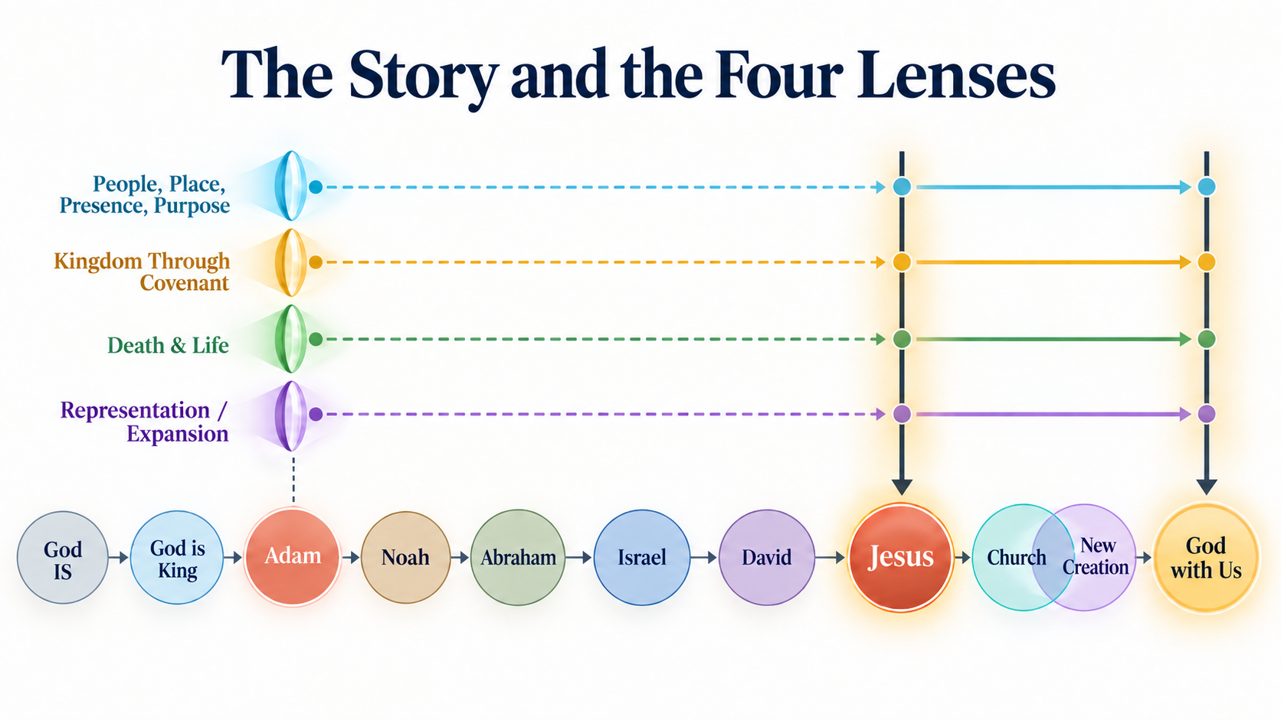
Already, only at the second covenant moment in Scripture, we see the problem much clearer. When we look through the lens of People, Place, Presence and Purpose, we see that in his covenant with Noah, God continues to commit to his people and his purposes. God preserves his creation that he might continue to exercise his kingship over all things and through his covenants. The Noahic covenant is not a failed attempt to recreate Eden, rather it is God’s faithful commitment to sustain creation while accomplishing his purposes. Sin truly does lead to death and judgement. God graciously gives life THROUGH judgement. But humanity still sins, and death remains. Preservation grants continued life, but it cannot ultimately overcome sin and death.
Humanity needs more than another chance or just additional time. We need FORGIVENESS of sins and heart MADE NEW. God is preserving creation and his people because of what he intends to do through his very son, Jesus Christ. Through Christ, God will bring his people into the fullness of the promised kingdom.
Summary
How would you try to say all of this today? Everything I just said about Noah and what God did by establishing his covenant with Noah and accomplishing preservation for his people and his purposes? I want to give you a minute to write something down.
Again, here is my version, but it is okay if yours is different:
By Noah’s day the earth is filled with violence, and God judges it through the Flood. For a moment it looks almost like a new beginning—a fresh world, another Adam-like family, another command to fill the earth. But the human heart has not changed. A fresh start is not enough. Judgment can remove sinners, but it cannot make sinners new. Yet God does something astonishing: knowing exactly what humanity is, he promises not to abandon his creation. He covenants with Noah to preserve the world so that his purposes can continue. God will not overlook sin, but he will not abandon what he made.
For Discussion
Sermon Summary
By the time we reach Noah, humanity has thoroughly corrupted God’s good creation. God sees the wickedness of the world and brings judgment through the flood. Yet in the midst of that judgment, Noah finds favor in God’s eyes. Noah is not chosen because he has earned God’s favor. Like the other people God uses throughout the Story, he receives grace, responds in faith, and walks in obedience (Genesis 6:8–9; Hebrews 11:7).
Through the flood, God preserves Noah and his family. When the waters recede, the world looks like a new creation: dry ground emerges, living creatures return, and God again commands humanity to be fruitful, multiply, and fill the earth. God establishes his covenant with Noah, his descendants, and every living creature, promising never again to destroy all flesh by a flood. The rainbow is the sign of that promise.
But the new beginning does not produce new hearts. Noah sins, and humanity rebels again at Babel. If the flood were simply an attempt to start over with better people, it would seem to have failed. Yet God already knew that the human heart remained sinful (Genesis 8:21). His covenant was not a failed attempt to transform humanity; it was his faithful promise to preserve creation so that his Kingdom purposes would continue through the rest of the Story.
That promise also changes how we see God’s patience. We ask why God does not immediately confront the sin around us, forgetting that he sees our sin too. Every day we live within his preservation. He gives us time to hear his Word, repent, believe, grow in obedience, love others, and glorify him. As Romans 2:4 and 2 Peter 3 remind us, God’s patience is not indifference or permission to continue in sin. It is an expression of his kindness calling us to repentance. And still, we need more than time or another chance: we need forgiveness and hearts made new through Jesus Christ.
God will not overlook sin, and God will not abandon his creation. He preserves the world for his purposes, even as the continuing problem of the human heart points us toward Christ.
Discussion Questions
Genesis 6 describes a world so corrupt that God announces judgment. The sermon asked, “God, do you see this?” When are you most likely to ask that question? How does knowing that God sees both the world’s sin and your own affect the way you respond?
Noah “found favor in the eyes of the LORD” (Genesis 6:8), and Hebrews 11:7 describes his response by faith. Why does it matter that God’s grace comes before Noah’s obedience? Where are you tempted to think you must be good enough for God to work through you?
After the flood, Noah and his family receive a remarkable new beginning, but sin soon returns. The sermon said, “We don’t just need a second chance. We need new hearts.” Where have you seen the limits of a fresh start—in your own life or in the world around you? Why is a change of circumstances not enough?
God knew the human heart remained evil when he promised to preserve creation (Genesis 8:21–22; 9:8–17). What does this teach you about his faithfulness and his commitment to his purposes? How does it help you understand the larger Story moving toward Abraham, Israel, David, and Jesus?
The sermon said, “God’s patience isn’t indifference.” Romans 2:4 connects God’s kindness to repentance, and 2 Peter 3 connects his patience to coming judgment. How might your attitude change if you asked, “God, why have you been so patient with me?” What opportunities is he giving you now to repent, grow, love others, and glorify him?
Preservation gives us time, but it cannot make our hearts new. How does that distinction help you understand what we need from Jesus? In what ways does God’s faithfulness give you hope as the Story continues?